
Frequently Asked Questions
Where is the proposed site?
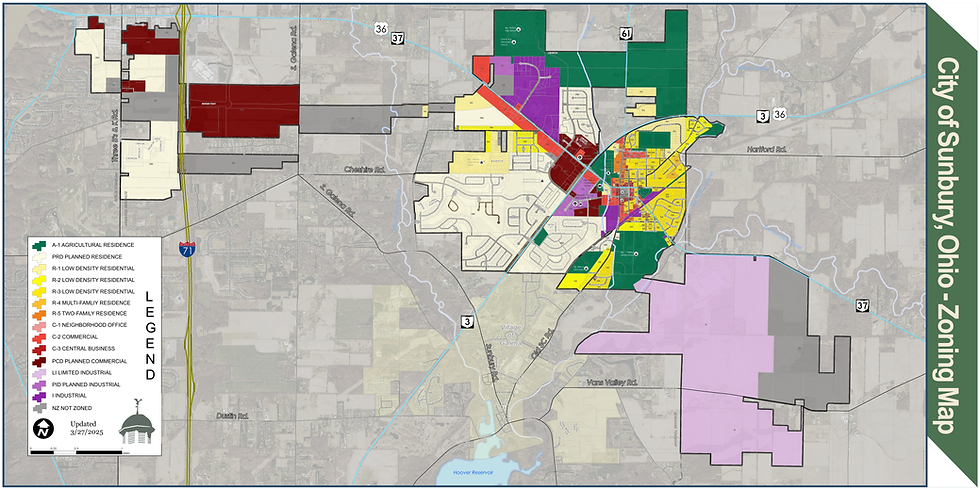
The City of Sunbury zoning map shows the broader annexed and zoned area. The proposed AWS data-center campus is within the Sunbury Business and Technology Park on the east side of Sunbury. A final AWS site plan has not yet established exact building locations.
* Please note - The zoning map is from the city of Sunbury's website and dated 2025. Since its publication, the Business and Technology Park has annexed additional land and now totals close to 1500 acres, making the only available publication outdated.
How close is the proposed data center site to schools?

Big Walnut Middle School is less than one mile from the proposed Amazon property shown on the map. The measured map distance is approximately 0.92 mile. Final generator, cooling-equipment, and building locations are not yet public.
What are the main noise concerns?
Noise can be both intermittent and longer-duration. Generator testing can create louder temporary sound, while cooling fans, HVAC equipment,
transformers, and other mechanical systems can create lower-level sound for extended periods. When additional power is needed they can run 24/7.
Different frequency ranges can matter. Large fans, generators, HVAC systems, and transformers can contribute low-frequency sound; fan and mechanical noise also extends into mid and higher frequencies.
Why schools matter: WHO guidance has long used 35 dB(A) as a classroom background-noise target, and a WHO-supported systematic review found evidence linking chronic environmental noise exposure with poorer reading/oral comprehension and long-term memory in children under some conditions.
What about air emissions and backup generators?
EPA identifies stationary engines and combustion turbines as common sources of primary and backup power for data centers. For scale, a Pennsylvania DEP permit for an Amazon Data Services facility in Falls Township authorized 72 diesel-fired emergency generators rated at 2.5 MW each (180 MW total), plus four smaller house generators.
A Caterpillar 2.5 MW standby-generator specification lists fuel use of about 173.5 gallons per hour at full load - about 4,164 gallons in 24 hours for one unit. If 72 comparable units operated at full load for 24 hours, that would be about 299,800 gallons of diesel.
This is an illustrative calculation, not a forecast for Sunbury; Sunbury-specific generator count, model, load and run time are not yet public.
What do we know about water and wastewater?
Sunbury's hydrologic study modeled 2.5 million gallons per day of consumptive withdrawal by a connected end user. That is a planning assumption used in the study, not proof of AWS's final operating demand.
Reclaimed-water cooling is being planned. Sunbury's design memo describes a non-potable reuse system intended for data-center cooling and industrial uses.
Wastewater path: Sunbury says its treatment plant discharges to Prairie Run, a tributary of Big Walnut Creek, which ultimately flows to Hoover Reservoir. Little Walnut Creek also feeds Hoover Reservoir, but it is not the treatment plant's direct discharge route.
Del-Co Water: At Sunbury's June 25 data-center meeting, Del-Co said the proposed Amazon project could become the single largest water user on its regional system during peak demand. Del-Co does not state that it opposes data centers; instead, it says any large-demand user must undergo a comprehensive evaluation so existing service levels are not negatively affected, and project-related costs are not shifted to residential or smaller commercial customers.
What about PFAS and other cooling-water chemicals?
Cooling systems can require chemicals to control scale, biological growth, and corrosion. The exact chemical list for the Sunbury project has not yet been publicly established.
PFAS are persistent chemicals, and some can remain in people and the environment for years. EPA links exposure to certain PFAS with several health outcomes.
What about electricity and the electric grid?
AEP Ohio uses 25 MW as the threshold for its special Data Center Tariff and load-study process. FERC has reported that the average size of data centers entering service grew from about 25 MW in 2020 to almost 80 MW in 2025.
AEP says its tariff is intended to place project-driven infrastructure costs on the data-center customer and reduce the risk of shifting speculative costs to other customers. Federal regulators are also examining large-load reliability, transmission upgrades, and cost allocation.
Local control and potential on-site generation: If AWS were to propose a qualifying on-site power plant, the approval process for that utility facility could be handled primarily through the Ohio Power Siting Board under state law rather than through the same local land-use process residents might expect for an ordinary development project. Refer to the Amazon Data Center in Hilliard. Amazon recently went around Hilliard and Norwich Township to establish there own power source and move forward despite neighbor objections.
A petroleum pipeline exists in the area. What are the potential concerns?
Sunbury's Parkway Master Plan identifies a 6-inch Marathon petroleum/oil transmission pipeline crossing the broader study area near South Galena Road, close to a 345-kV electric transmission line. The line is petroleum/oil - not natural gas.
PHMSA says development near transmission pipelines can increase both the likelihood of pipeline damage and the potential consequences of a failure. Its guidance calls for attention to easements, excavation and construction, pipeline-operator access, emergency response, and separation from proposed facilities. PHMSA also identifies excavation damage as a major pipeline-safety concern.
The final AWS site plan is not public, so the distance between proposed buildings or construction activity and the pipeline is not yet established.
What does the 25 MW threshold mean?
The proposed amendment uses greater than 25 MW as part of its definition of covered data centers. For context, AEP Ohio also uses 25 MW as a threshold for its data-center tariff process, while FERC reported an average of almost 80 MW for data centers entering service in 2025.